
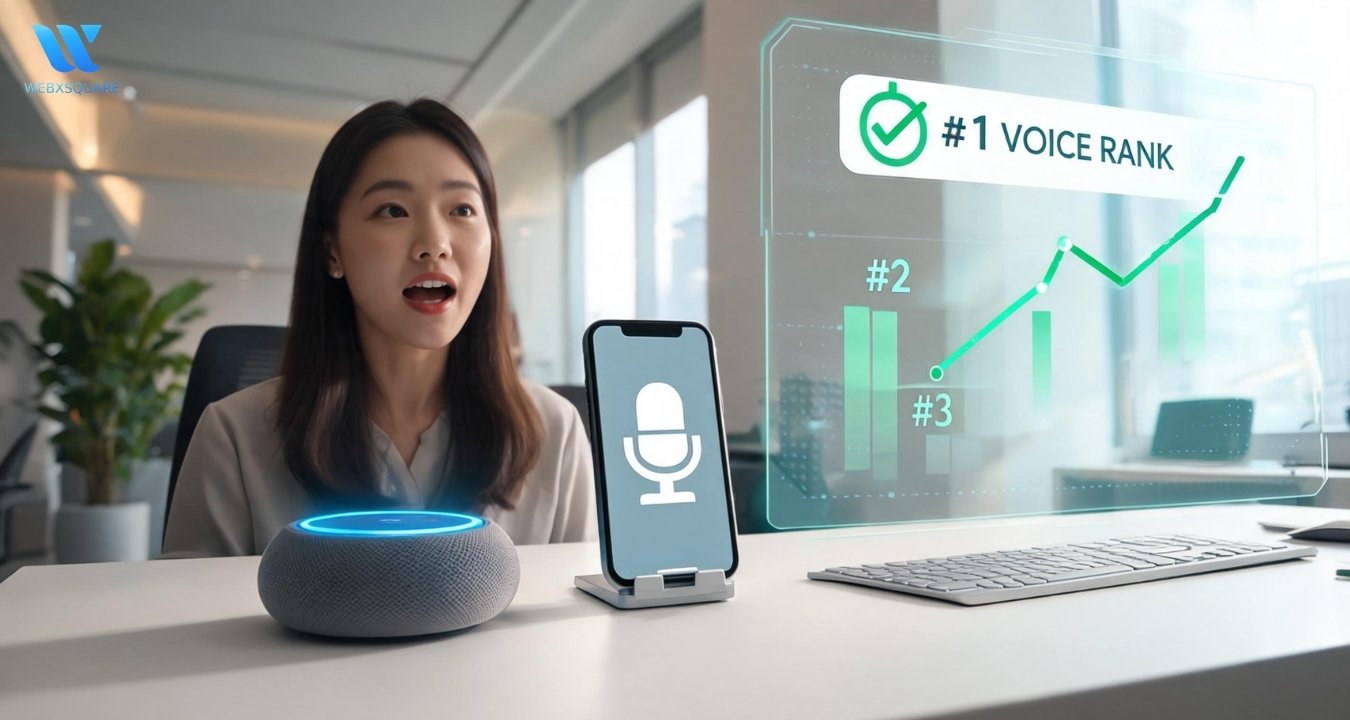
Many people do voice search rather than typing. Instead, they are able to speak their entire questions out loud to their phones, speakers, and cars today. Voice search optimization has, thus, emerged as one of the highest SEO priorities of businesses. By 2026, the number of voice assistants in operation all over the world has reached 8.4 billion, which is greater than the number of people on Earth. As a result, voice search has reached 27 percent of all search queries that are done on a daily basis. Nowadays, people in the US normally do voice search on a daily basis.
How Voice Search Differs From Traditional Text Search
It is only by knowing the true distinction between voice and text search that alters your whole content strategy. Also, the language spoken by people is radically different to the language typed by people when typing search queries. The majority of businesses continue to optimise on typed search and do not even bother to look at the voice audience at all.
Conversational vs Fragmented Keywords
Someone types using small bits such as best pizza London to find fast. Moreover, a person will pose full natural questions such as where can I find the best pizza around me when he or she is talking. The outdated stratagem of brief key-words and thick text-walls is no longer a winner in 2026.
One Answer vs Ten Blue Links
Customary search presents the top ten results and allows users to choose the most suitable one themselves. Moreover, voice search reads out all the answers one can find, one at a time, the most suitable one possible. Over 80 percent of the voice search results are found in the first three search results.
Additionally, approximately half of the voice search results are the snippet box of Google. This is either your content is the solution or you just do not have a voice search business.
The 7 Voice Search Optimization Strategies for 2026
Strategy 1: Target Conversation and Keywords
The key takeaway is to no longer create your content using short keyword fragments and begin working on targeting full natural questions. Moreover, consider such tools as AnswerThePublic, People Also Ask, and Search Console to get actual questions. Create whole pages or even sections in the response to one specific question in as clear a way as possible.
Compared to short-tail keywords, long-tail keywords are 2.5 times more effective in optimizing voice search. Further, voice SERP is dominated by question based content with the use of who, what, where, when, why and how. So, base your key word strategy all the way around the natural language of your customer talking about their issues.
Strategy 2: Win Featured Snippets at Position Zero
The snippet that will be featured is the short answer box, which is located above the other Google search results. Moreover, voice assistants nearly always read the featured snippet as the speech snippet to the users. In all query types, featured snippets drive 40.7% of all voice search responses.
In addition, you need to answer first to win a featured snippet by giving a direct, clear, and concise answer. Immediately follow that answer with explanation, examples or a list format below. Thus format all key pages by having a definite question and a concise direct answer.
Strategy 3: Optimization for Local Voice Search Intent
Voice search is increasing day by day than any other type of search. A fifth of voice search users seek local business information daily.
In addition, voice search of local businesses has a conversion rate of 76% to in-person visits within the same day. This implies local voice search optimization is directly translated into real-life foot traffic and income. Hence, voice search should become the most important local SEO channel of every local business at the moment.
Strategy 4: Make Your Page Load in Under 4.6 Seconds
The technical factor that cannot be compromised when it comes to ranking in voice search results is page speed. Pages that rank for voice search load 52% faster than average search result pages. Moreover, voice search results take 4.6 seconds on the average in all ranking pages.
In addition, slow pages never show up in voice search results whether the content is good or not. Run Google PageSpeed Insights and correct your Core Web Vitals and then concentrate on other things. Thus, speed is the technical basis that all the other voice search optimization strategies rely on entirely.
Strategy 5: Add Schema Markup and Structured Data
Add FAQ schema, LocalBusiness schema and How To schema to all your appropriate pages.
In addition to this, schema assists Google to extract correct information in your pages without making any guesses. This clean structured data is then used by voice assistants to provide accurate verbal answers with confidence. Hence, schema markup is among the greatest returns of your voice SEO strategy.
Strategy 6: Build an FAQ Section on Every Key Page
The most natural and effective voice search query capture is in the form of FAQ. Moreover, each of the questions in your FAQ is just how a real user addresses his/her voice assistant. Write up each FAQ so that it has a clear question as the heading and a straight forward concise answer below the question.
Furthermore, your FAQ answers should be less than 50 words, as this is the average length of voice search answers. This format also gives you more likelihood of being featured snippets on several similar queries at the same time. So, make sure to add a well-researched FAQ section to each major service, product, and landing page that you possess.
Strategy 7: Write at a Ninth-Grade Reading Level
Minimize your length of sentences, employ simple language and use the conversational tone on your important pages. Apps such as the Hemingway App can be used to quickly quantify and refine the readability rating of your content. Thus, easier and more straightforward writing not only is more human but also a quantifiable voice SEO ranking criterion.
How to Optimize Your Google Business Profile for Voice Search
The most valuable local voice search asset is your Google Business Profile. Always ensure that your business name, address and phone number remain the same in all online sites. Besides, add your business type, services, photos and detailed description of your business to your profile. Always respond to all reviews as quickly as possible since 88 percent of consumers have more trust in companies whose owners reply to all their reviews. Thus, consider your Google Business Profile as your most important voice search optimization tool at all times.
Answer Engine Optimization: The Next Step Beyond SEO
Traditional SEO will have you ranked in a list of links that people will be clicking and scrolling. Moreover, Answer Engine Optimisation, AEO is aimed at becoming the single spoken answer. SEO is now practiced in conjunction with AEO and Generative Engine Optimisation (GEO).
Additionally, AEO implies the organization of each piece of content to directly respond to one concrete question in the real world. GEO refers to appearing in search results of AI-generated answers in Google and other websites.
How to Measure Your Voice Search Performance
It is not yet possible to directly filter pure voice traffic within Google Analytics in 2026. Moreover, indirect voice performance can be tracked by the use of multiple measurement techniques that are reliable and actionable. These are the indicators to monitor to know the true performance of your voice search optimization.
- Track featured snippet victories in Google Search Console on question based searches that you target.
- Keep an eye on long-tail question key ranking in such tools as Semrush or Ahrefs.
- Monitor traffic boost on FAQ pages and pages where the question-answer format is evident.
- Monitor the number of views, calls, and direction requests on your Google Business Profile as local voice indicators.
- Check your Core Web Vitals and page speed remain optimised with Lighthouse audits.
- Track overall organic mobile traffic because 58 per cent. of the voice search is via mobile.
FAQs
What are the benefits of featured snippets to voice search ranking?
The percentage of voice search answers that assistants read to the user is powered by featured snippets (40.7%). Moreover, the most effective voice SEO tactic that can be used is to organize your information in such a way that it will capture snippets.
What is the reason why local SEO is significant with voice search?
76% of all voice searches include local intent with users asking for nearby businesses and services. Moreover, 76 percent of local voice-searching leads to a real-world business visit within the same day by the user.
Does schema markup provide any benefit to voice search ranking?
Yes, 33% of the pages containing schema markup are more likely to be featured in voice search. Additionally, the structured data voice assistants are fed directly on FAQ schema and LocalBusiness schema.
What is the speed requirement of my page to voice search?
The average voice search results take 4.6 seconds to load which is 52% of the time compared to typical pages. Moreover, any page that loads slower than this would be virtually invisible to voice search ranking mechanisms.
Conclusion
Voice search optimization will not be an additional feature in a progressive business in 2026. The opportunity is huge with 8.4 billion voice assistants in operation and 27% of all searches being spoken-out. Thus, companies that are operating according to voice SEO today have a major head start over their slower rivals.
Moreover, strategies in this guide are a system and not individual tactics. The use of conversational keywords, featured snippets, local search, rapid pages, and schema markup all work together synergistically. Therefore, a multiplied and sustainable voice search advantage in the long-run is achieved through the implementation of all seven strategies. Invariably write the way your customers speak and not the way they typed back in the past.
Should you require professional assistance in developing a voice-enabled, technically-optimized, and high-ranking web site, Webxsquare provides professional SEO and web development services tailored specifically to the way your customers will be searching in 2026.