
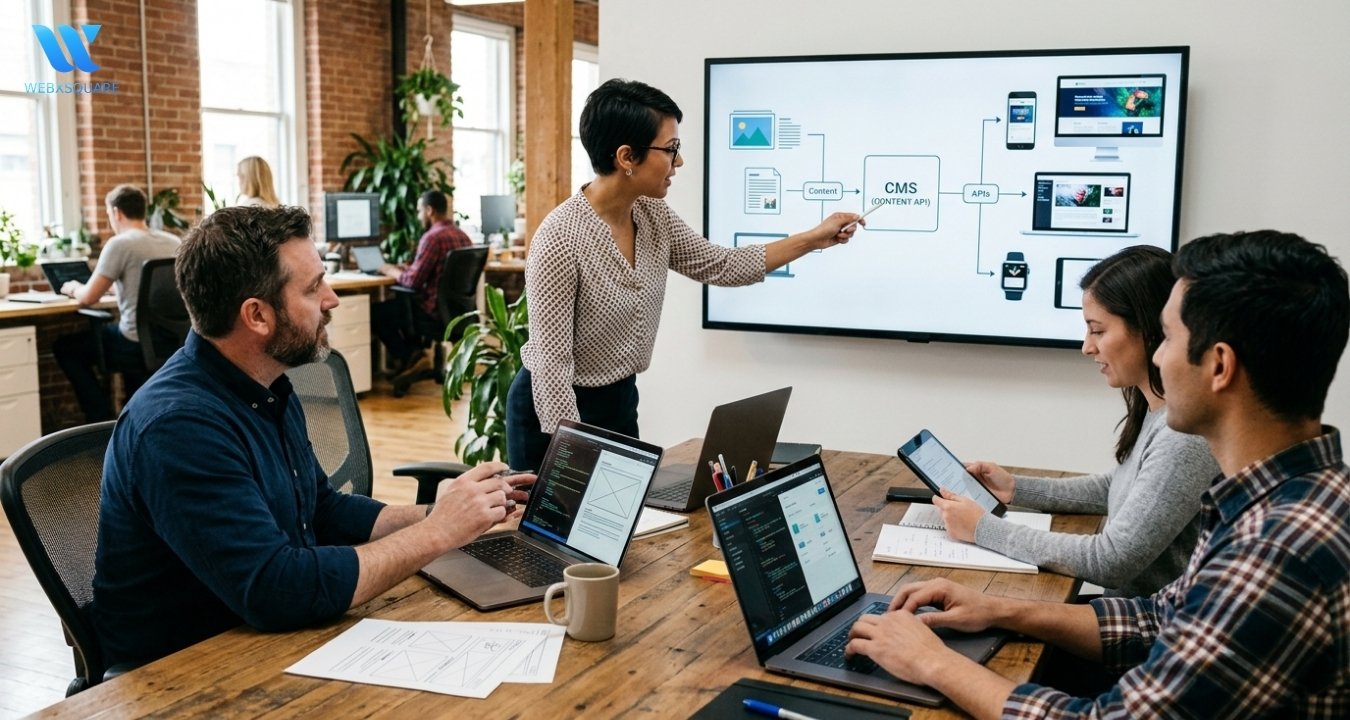
The content system in your web site is either contributing or undermining your business either knowingly or unknowingly. The majority of companies continue to operate platforms that were created in a much less complex internet. Thus, the manner in which the content is published and delivered has now totally transformed in 2026. In addition, consumers now demand your brand in websites, apps, and voice assistants all at the same time. There is also a February 2026 update to Google which also rewards the brands which provide excellent and fast digital experiences. This guide details what a headless CMS is and whether you should switch now.
What Is a Headless CMS? A Simple and Clear Explanation
The term headless is technical and the concept is very easy. Moreover, there is no need to know more than how your existing content system is already functioning today. When you have a clear view of the difference, then the decision to switch becomes a lot easier and more sure.
How a Traditional CMS Works
A conventional CMS such as WordPress has control of what you post and the appearance of it on the internet. Moreover, there is no separation between the backend on which you are writing and the frontend on which users read. Consider it to be a kitchen and dining room constructed permanently in the same room.
This is okay with just a simple site but a real nightmare when your business develops. Additionally, updating your design usually involves updating your content simultaneously as well. Thus, the conventional platforms are an excellent fit in one channel, but they fail horribly when your requirements grow.
How a Headless CMS Works Differently
A headless CMS keeps your content and where it is displayed apart. Moreover, data is stored as clean data and is on-demand at any location via APIs. Consider it as a content factory that feeds content on any channel on demand.
Besides, your developers will be able to create your site with React or Next.js and any other framework of your choice. Headless sites are always 40% quicker to load than standard CMS sites. Thus, a headless CMS will provide your company with the total freedom of design, speed, and content delivery.
Key Benefits of Headless CMS for Your Business
Significantly Faster Website Performance
Speed has become a business metric that can influence rankings and revenue jointly. Headless architecture sites are 40% faster at Time to First Byte in comparison to traditional CMS. Moreover, headless sites deliver content via global CDNs to have pages load almost instantly anywhere.
Any change of one second in the load time results in a conversion of 2%. Additionally, the February 2026 update by Google explicitly incentivizes fast and mobile-first website experiences. Thus, the headless CMS feature of speed directly increases your rankings and revenue.
Deliver Content Across Every Channel at Once
Eighty two percent of companies say that headless systems make their entire content delivery process a lot easier. Furthermore, 92% of US ecommerce brands are now by default composable commerce. This implies that businesses integrate their optimal tools using API-first content infrastructure effectively. Hence, future-proof your content strategy in all channels today and tomorrow, without a head.
Better Security with a Reduced Attack Surface.
Traditional CMS platforms have grave and well-recorded security vulnerabilities in 2026 today. Sucuri 2025 indicates that about 90% of hacked CMS websites are powered by WordPress. In addition, the presence of plugins and exposed administrator panels also provide easy access points, which are actively used by the hackers every day.
Headless CMS eliminates the public facing backend entirely out of the attack surface of your site. Additionally, your content API also works independently and direct attacks are much harder to do by hackers. As such, headless switching is one of the best security upgrades that your business can make.
Complete Design and Technology Freedom
Developers in the traditional CMS platforms are always in a tight spot in hard-to-customize templates. Moreover, headless allows your team to develop with React, Vue, Next.js, or any current framework. This speeds up development and lets your team adopt new tools without any vendor restrictions.
Good Scalability for Business Growth
Headless architecture spreads content globally to CDN nodes and scaling is always easy. Your site is easy to use on the busiest day of the week. In the Netherlands, 86 percent of the headless CMS users stated that they had a distinctly improved ROI following a switch. Additionally, 70 percent of businesses in Germany reported to have improved real performance and scaling after the migration. So, scalability is the only reason to consider headless a truly intelligent long-term investment in every expanding company.
Contentful
Contentful is the business-level solution with high-quality APIs and a well-developed ecosystem. Moreover, it is compatible with marketing tools, ecommerce, and analytics. Developers of large groups, having complexities in multi-channel needs, always prefer using contentful due to its richness and dependability.
Sanity
Sanity provides live collaborative working, content modelling, and querying. Moreover, it is appropriate in developer teams that require the greatest level of flexibility and a code-first content strategy. Real-time editing of Sanity makes it one of the most collaborative headless platforms at the moment.
Storyblok
Storyblok fills the gap between freedom and visual editing tools by developers. Moreover, non-technical editors have the ability to create and preview pages aesthetically without the need to touch any code. This renders Storyblok among the most accessible headless solutions of mixed technical business teams.
Strapi
Strapi is an open source, self host, solution that provides businesses with total control of their infrastructure. In addition, it is appropriate in technical teams that desire complete customisation without subscription charges of costly SaaS. Strapi is super effective with startups who develop bespoke digital experiences with smaller and constrained budgets.
What Will Headless CMS Cost in 2026?
- Simple website migration to headless: $8,000 to $25,000
- Mid-level business headless build $25,000 to $75,000
- Complex ecommerce headless platform $50,000 to $150,000
- Enterprise multi-market headless build $100,000 to $500,000+
Platform licensing introduces a monthly fee that can include a free or enterprise-level license. Moreover, the business plans of Contentful and Storyblok usually fall within the range of $500-3000 per month. Thus, you should always plan on continuing development and infrastructure costs of your platform accordingly.
How Long Does a Headless CMS Migration Take?
An average migration lasts between four and twelve weeks based on the amount and complexity of the content. Moreover, the bigger the enterprise migration with thousands of pages, the more time it will require to accomplish.
Type of Migration Characteristic Timeline
- Simple brochure website: 4 – 6 weeks
- Complex online shopping or multisites: 10-20 weeks.
- Enterprise multi-market platform: 20 -40 weeks.
When Should You Stick With a Traditional CMS?
Headless is not the correct solution to all business cases and budgets. Moreover, certain businesses will be much better-served by remaining with their current platform in the meantime. Thus, think about remaining with traditional CMS in case the following circumstances suit your business nowadays.
- Your company lacks front-end development capabilities and technical skills in-house.
- You are establishing a plain brochure site and you do not have to distribute through multi-channel.
- Your content editors should have drag-and-drop editing and are not comfortable with structured content.
- You have a small budget and you just cannot afford to develop a custom frontend at the moment.
- You are in your initial stages of business, speed to market is much more important than performance.
Signs Your Business should Switch to Headless CMS
- Your site is slow and does not follow Google Core Web Vitals performance.
- You must provide content in a combination of a site and an app and other online platforms.
- You have either had security breaches or a major worry regarding the vulnerability of WordPress plug-in.
- Your content team is losing time reworking the same content in each of the channels separately.
- You are going global and require localisation of several markets and languages.
- You would like to introduce AI content robotisation and individualisation systems in your content process.
FAQs
What is the working of CMS?
A headless CMS is a content management system that isolates your content backend and front end and provides content via APIs.
Should I migrate my WordPress to a headless CMS?
Change to multi-channel delivery, enhanced performance, enhanced security, or flexibility with the developer. Also, remain with WordPress when your team does not have technical resources or only wants a simple site.
Will a headless CMS be the best in 2026?
Yes, but when constructed properly with server-side rendering or full crawlability with a static site. Also, headless sites are always rated higher on Core Web Vitals that directly enhances Google rankings.
What is the cost of the headless CMS development in 2026?
Basic migrations start at $8,000 and ecommerce constructions have the price between $50,000 and 150,000. Moreover, monthly platform licensing will cost you between zero to $3000 depending on the platform and plan you select.
Is it possible to use a headless CMS by small businesses?
Yes, there are other platforms such as Strapi and Storyblok that have free plans that are much more affordable. Moreover, headless performance and security can be of great advantage to small businesses that have a competent developer.
Conclusion
Headless CMS is not only a thing of big companies that can afford to spend a lot of money and resources on development anymore. It is the viable option in 2026 to any business, which requires flexibility, security and speed. Thus, when your existing platform is slowing down your team, headless should be given due consideration now. Always consider your platform selection based on your team abilities, budget and actual business needs first. Webxsquare offers headless development services that can provide you with the means to fully migrate to a headless CMS.